
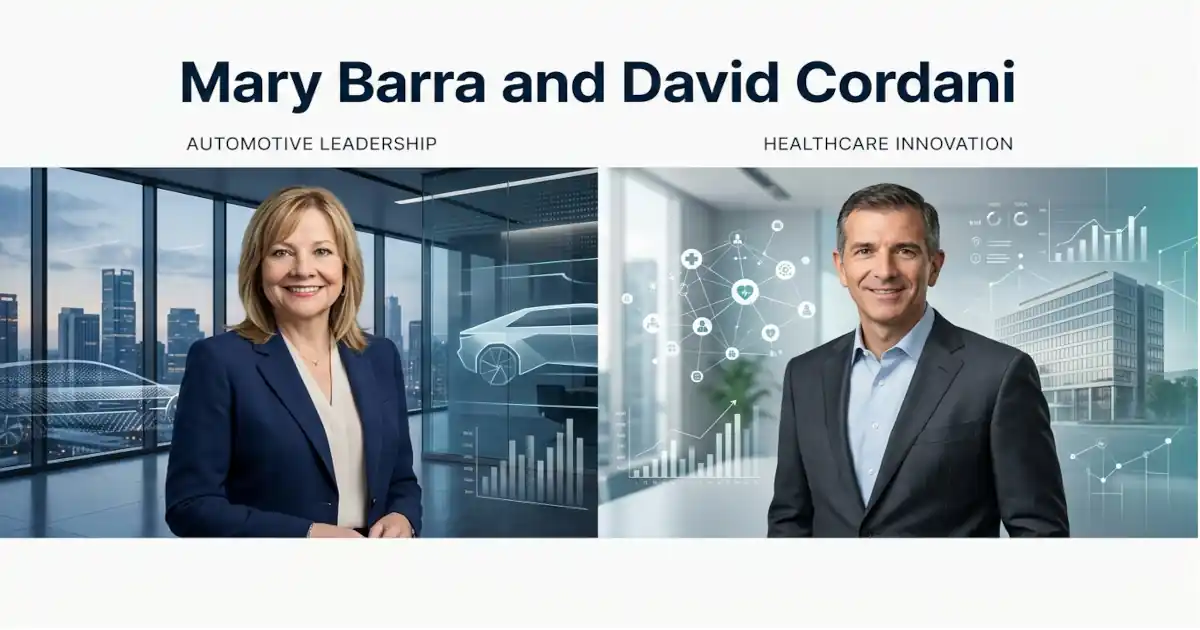
Corporate America produces few leaders who reshape entire industries. Mary Barra and David Cordani belong to that rare group. Each one built a career through decades of steady, deliberate work. Each one eventually reached the top of a Fortune 500 company. Their industries differ sharply, yet their leadership lessons often overlap. This article explores their backgrounds, their achievements, and what professionals can learn from both.
Who Is Mary Barra?
Mary Barra leads General Motors as Chair and Chief Executive Officer. She started at GM in 1980 as a college co-op student. She studied electrical engineering before joining the company full-time. Over the following decades, she rose through several demanding roles. She worked in manufacturing engineering, human resources, and global product development. That broad experience gave her a rare, complete view of the automaker.
Barra became CEO in January 2014. Her appointment made history immediately. She became the first woman to run a major global automaker. That milestone alone earned her lasting recognition across the business world. But her impact extends far beyond that single achievement.
Under her leadership, GM pushed hard into electric vehicles. The company committed billions of dollars toward EV development. Barra also prioritized safety, software, and autonomous driving technology. She reshaped GM’s culture around innovation and accountability. Her engineering background gave her credibility on technical decisions. Her operational experience gave her credibility on business strategy.
Barra also serves on GM’s Board of Directors as Chairman. She became Chairman in January 2016, two years after taking the CEO role. That dual position gives her direct influence over board decisions. It also lets her align long-term governance with daily operations. Few executives hold both titles at a company of GM’s size. That structure reflects the board’s confidence in her judgment.
Her tenure has not been free of challenges. GM navigated supply chain disruptions, chip shortages, and shifting consumer demand. Barra managed those disruptions without abandoning long-term EV commitments. She often described patience as a core leadership value during difficult stretches. That steady approach helped GM maintain investor confidence through uncertain periods.
Who Is David Cordani?
David Cordani built his career inside the health insurance industry. He joined Cigna in 1991 and stayed for decades. He earned an MBA from the University of Hartford in 1995. That combination of education and hands-on experience shaped his leadership style.
Cordani became Cigna’s Chief Executive Officer in 2009. He led the company through major shifts in health care policy. He also guided Cigna through significant mergers and structural changes. His focus remained on customer-centered health solutions throughout his tenure. In March 2026, The Cigna Group announced his planned transition. Cordani stepped down as CEO on July 1, 2026. Brian Evanko, previously President and Chief Operating Officer, succeeded him. Cordani then became Executive Chair of Cigna’s board. That move allowed him to stay involved at a strategic level. It also gave Evanko room to lead daily operations independently.
Cordani’s seventeen years as CEO produced significant organizational change. He oversaw Cigna’s expansion into broader health services beyond traditional insurance. He also guided the company through complex regulatory environments across multiple presidential administrations. Few health insurance executives match his length of tenure at the top. That longevity gave him unusual influence over industry standards and practices. Colleagues often described Cordani as a steady, methodical decision-maker. He avoided reactionary moves during periods of market volatility. Instead, he favored gradual, well-researched strategic shifts. That approach mirrored the patient, long-term thinking common among successful Fortune 500 leaders.
Why People Compare These Two Executives
Search interest often links Mary Barra and David Cordani together. Both are prominent, well-known Fortune 500 executives. Both built long careers inside single companies before reaching the top. They hold MBAs and technical or operational backgrounds. These similarities create natural points of comparison for business audiences. No public evidence suggests any personal or family connection exists. Their relationship is professional, not personal. They represent two paths toward the same destination: the corner office. That shared destination explains why their names appear together online.
Comparing Leadership Styles
Barra leads through a strong engineering mindset. She emphasizes precision, data, and long-term product planning. Her decisions often reflect careful technical analysis. She also communicates GM’s vision with clear, confident messaging. Cordani leads through a services-oriented mindset. Health care demands constant adaptation to regulation and customer needs. His decisions often balanced financial performance with patient outcomes. He built teams that could respond quickly to policy changes.
Despite these differences, both leaders share core traits. Both value transparency in corporate communication. They prioritize long-term growth over short-term wins. Both invested heavily in employee development programs. Both faced significant industry disruption and adapted successfully.
Career Paths That Built Two CEOs
Mary Barra and David Cordani followed strikingly similar career structures. Both started in entry-level or early-career positions. Both spent decades climbing through internal promotions. Neither arrived at the top through outside hires or lateral jumps. That internal growth gave both leaders deep institutional knowledge. This path matters for aspiring executives today. Internal promotion often builds stronger organizational trust. Employees see leaders who understand daily operational challenges firsthand. Barra and Cordani both benefited from that credibility. Their teams respected decisions built on real operational experience.
Key Lessons From Their Careers
Professionals across industries can learn from these two executives. Several lessons stand out clearly.
- Commit to continuous learning throughout your career.
- Build expertise across multiple departments, not just one.
- Earn leadership roles through consistent, measurable performance.
- Communicate company vision with clarity and confidence.
- Balance short-term results with long-term strategic investment.
- Support internal talent development at every level.
- Adapt quickly when industry conditions shift unexpectedly.
These principles apply well beyond automotive and health care industries. Any professional can apply them in any sector.
Industry Challenges They Both Navigated
The automotive and health insurance industries face constant disruption. Mary Barra and David Cordani each managed serious industry pressure. Barra confronted the shift toward electric and autonomous vehicles. Legacy automakers risked falling behind newer, tech-focused competitors. She responded with major capital investment and cultural change.
Cordani confronted rising health care costs and shifting regulations. Insurance companies faced growing pressure to control expenses. He responded by focusing Cigna on integrated health services. Both executives turned industry threats into strategic opportunities. Their responses reveal a shared leadership quality: adaptability. Neither leader resisted change out of comfort or habit. Both restructured major parts of their companies when needed. That willingness to adapt kept both companies competitive.
Recognition and Public Profile
Mary Barra holds a highly visible role in American business. She has served as Chair of the Business Roundtable. That organization represents leading CEOs across major industries. Her voice carries weight on national economic policy discussions. David Cordani also built a strong public profile. He has spoken at respected forums, including the Economic Club of Washington. His insights on health care policy attract wide industry attention. Both leaders regularly appear on lists of top executives.
This visibility reflects more than personal ambition. It reflects genuine influence over their respective industries. Business audiences trust their perspectives on strategy and leadership. Media outlets frequently feature both executives in leadership rankings. Financial publications cite their decisions when analyzing broader market trends. Analysts often reference their strategies when evaluating competitor companies. That level of attention places both leaders among the most closely watched executives in America. Their decisions ripple far beyond their own organizations, influencing supplier networks, competitors, and policymakers alike.
What Comes Next for Both Leaders
Mary Barra remains active as GM’s Chair and CEO. She continues guiding the company through its EV transition. Her focus stays on technology, safety, and long-term growth. Industry observers expect her influence to continue for years. David Cordani now serves as Executive Chair at Cigna. His operational responsibilities have shifted toward board-level strategy. Brian Evanko now manages daily leadership as the new CEO. Cordani’s experience still shapes Cigna’s long-term direction from the boardroom. Both leaders continue shaping conversations about corporate leadership. Their combined careers span more than seventy years of business experience.
Final Thoughts
Mary Barra and David Cordani represent two distinct but complementary leadership stories. One transformed an automaker through engineering and innovation. The other transformed a health insurer through service and adaptability. Their industries rarely intersect, yet their leadership principles align closely. Both leaders climbed through internal promotion over many years. Both embraced change instead of resisting it. They built reputations for transparency and long-term vision. Their careers offer valuable lessons for any ambitious professional.
Studying leaders like these helps professionals understand real-world leadership. Textbooks describe leadership theory in abstract terms. Mary Barra and David Cordani show what that theory looks like in practice. Their decades of experience prove that patience, adaptability, and clear communication still matter most. Aspiring leaders can draw a simple takeaway from both careers. Success rarely comes from shortcuts or sudden breakthroughs. It comes from consistent effort, sound judgment, and a willingness to grow. Barra and Cordani each spent decades building that foundation before reaching the top. Their stories remain worth following as their industries continue to evolve.
READ ALSO: Learning With Games Fparentips: A Complete Guide For Parents